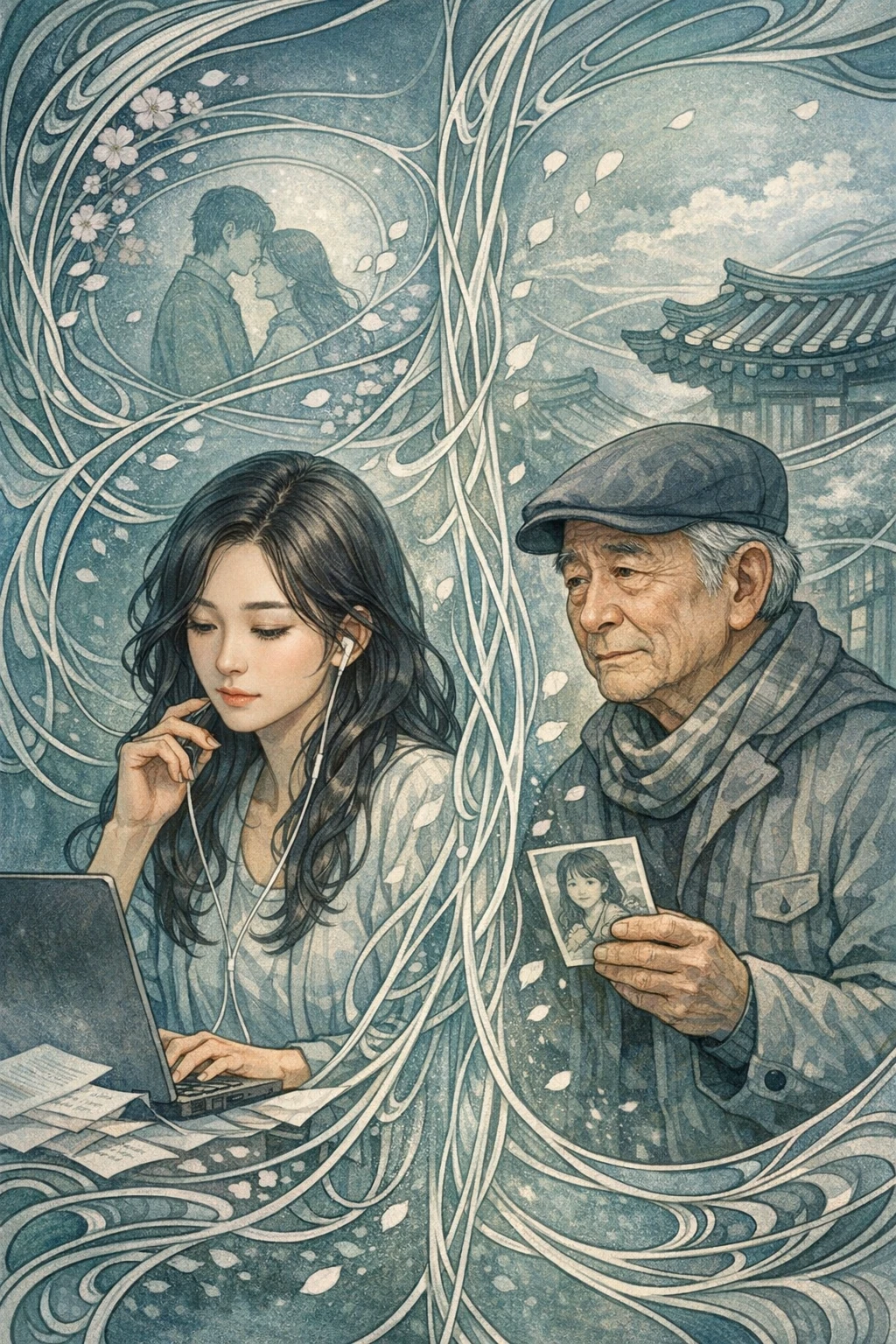
Words That Cannot Be Translated
소연Seo Ha-eum makes a living translating subtitles for Japanese dramas. She can deftly convey others' emotions, yet cannot write a single line about her own. Then, into the apartment next door moves an elderly man from Osaka who has come to Korea to find someone he lost thirty-two years ago. Between the two of them, untranslatable words begin to pile up. [Characters] Seo Ha-eum (31, freelance subtitle translator; outwardly detached and efficient but helpless when it comes to expressing her own feelings; keeps others at arm's length after a long-ago failed relationship), Araki Kenichi (62, retired salaryman from Osaka; speaks clumsy Korean laced with Kansai dialect; stubborn yet warm; has come to find the Korean woman he parted from in 1994) Words That Cannot Be Translated, Full Outline Episode 1: Noise Next Door, As Ha-eum races against a subtitle deadline, the thud of luggage and halting Korean threaded with Kansai dialect seep through the wall from next door. Episode 2: Not "Hello", Their first encounter in the hallway: Kenichi tries to say "How do you do" but mangles it into "I just saw you." Ha-eum corrects him offhandedly, and a brief conversation begins. Episode 3: Trash Day, While helping Kenichi sort his recycling, Ha-eum learns for the first time that he has come here looking for someone. A name, three syllables, and nothing more. Episode 4: An Address from 1994, Ha-eum looks up the address on a faded envelope Kenichi has brought, but the entire neighborhood has been erased by redevelopment. For the first time, Kenichi's composure falters. Episode 5: Natsukashii, The drama Ha-eum is translating uses the word 懐かしい (natsukashii), and she agonizes over the lack of a perfect Korean equivalent. Through the balcony partition, she overhears Kenichi murmuring the same word to himself as he gazes at an old photograph. Episode 6: Bean Sprout Soup, After finishing a deadline, Ha-eum makes bean sprout soup and, hearing coughing through the wall, brings a bowl next door. Kenichi tastes it and says, "This flavor, she used to make this for me." The silhouette of the lost woman emerges for the first time. Episode 7: A Scene Without Dialogue, Ha-eum hits a wall translating a scene where a character weeps in silence, there is nothing to subtitle. She asks Kenichi, "How do you translate a scene with no words?" He replies, "Maybe you don't have to." Episode 8: Rain in Osaka, Kenichi opens up about his years in Osaka. The rainy season of 1994, a small shop near Dotonbori, and a student who had come from Korea. For the first time, Ha-eum finds herself listening to someone else's past. Episode 9: A Seven-Digit Phone Number, An old notebook yields a seven-digit phone number. Ha-eum traces the defunct numbering system but hits a wall with archived district office records. Out of nowhere, her ex-boyfriend contacts her. Episode 10: The Unread Message, Ha-eum cannot bring herself to open her ex's message. Kenichi tells her he has thirty-two letters he never sent and shows her the bundle. She discovers they are all written in clumsy Korean. Episode 11: A Translation Request, Kenichi asks Ha-eum to translate his Japanese letters into Korean. She is about to refuse but ends up reading the first one. Amid the awkward sentences lies a density of emotion that defies translation. Episode 12: Don't Fix It, When Ha-eum tries to smooth out an awkward phrase during translation, Kenichi snaps. "Please deliver it as it is. Polished words are not my words." Their first clash. Episode 13: Suyu Station, Exit 3, Following a clue from the letters, Ha-eum and Kenichi walk together near Suyu Station. Where a bakery once stood, there is now a convenience store. "The smell is different," Kenichi says, stopping in his tracks. Episode 14: The Word 'Sorry', Ha-eum meets briefly with her ex. Afterward, she tells Kenichi, "Even after you receive an apology, nothing changes." Kenichi answers, "I haven't been able to apologize for thirty-two years." Episode 15: A Call from His Daughter, Kenichi's daughter calls from Osaka. She has no idea what her father is doing in Korea and demands he come home. It becomes clear that his reason for staying has been kept secret from his family. Episode 16: Finding the Name, Ha-eum tracks down an old alumni directory and finds a match for the name Kenichi has been searching for. But the woman passed away in 2019. Ha-eum cannot bring herself to tell him. Episode 17: The Weight of a Lie, Concealing the truth, Ha-eum tells him, "I'm still looking." She buries herself in her translation work. While subtitling a scene in which a character hides the truth, her hands go still. Kenichi looks into her eyes and senses something has changed. Episode 18: Where the Flowers Were, Kenichi arrives at the truth on his own. He visits the woman's old address and hears it from a neighbor. He stands before an empty flowerbed in long silence. Ha-eum catches up to him and finally speaks: "I should have told you." Episode 19: The Last Letter, Kenichi writes his thirty-third letter. This time, he does not ask for a translation. Ha-eum asks, "May I read it?" As she reads the letter he hands her, she voices her own feelings for the first time. "I, too, have words I never sent." Episode 20: Words That Cannot Be Translated, The morning Kenichi leaves for Osaka. In front of the taxi to the airport, Ha-eum hands him a small envelope. Inside is the manuscript, all thirty-two letters rendered in Korean, and one short letter Ha-eum has written to herself. The taxi pulls away, and Ha-eum opens the message she had left unread.
Contents

소연
평범한 사람들의 비범한 순간을 포착하는 일상 소설가.
Comments
No comments yet